
How might we streamline the workflow of a trucking shipper when booking quotes?
Portex Web Application
Portex is a venture capital backed startup focused on streamlining the freight procurement process. I lead foundational research to uncovering key personas and critical user journeys to help the team build a simpler and more efficient workflow for a shipper’s quotation process. The work supported the launch of the Portex web platform and a $1.4M pre-seed investment raise (Susa Ventures, Base10, and angels).
PROJECT DURATION
3 Months
MY ROLE
UX Researcher
Data Scientist
Product Manager
PRODUCT TEAM
UX Researcher
UX Designer
Lead Engineer
CEO
METHODS & TOOLS
User Interviews
Usability Testing
NLP with Python
Design & testing with Figma
THE PROBLEM
The global freight procurement process is very ‘old school’ and manual, with vital data points for quotations living in static Excel or PDF documents that are lost in tons of email threads. In addition to that, booking confirmations occur via email and on the phone.

RESEARCH OBJECTIVES
The Portex founding team and I set out to understand the current workflow of trucking shippers to identify their key pain points, goals and behaviours.
Understanding the Shipper workflow
I conducted user interviews with 20+ shippers from SME businesses and larger enterprises across the US, using the JTBD framework to understand :
Their supply chain
Their end-to-end workflows and tools used
The pains in these workflows
Their needs


Examples quotations that live in static emails, Excel and PDFs.
Thematic Analysis
A thematic analysis of all the feedback from user interview sessions helped me understand the key themes in the shipper’s current workflow and all their pain-points in this flow.

Shipper’s Pain-points
The thematic analysis of user feedback gave me insights on the biggest pain points in the shippers workflow:

Shipper’s Workflow
An average shipper carries out this inefficient and manual quotation process at least 40x times a week!
Manual data entry from Excel
Multiple email threads to manage
Manual data entry to Excel
Inefficient comparison methods prone to human error
Back and forth on email and phone calls, and inefficient document management
Manual report creation
No benchmarks for rate comparison
From the user interviews I built a clearer picture of the ‘shipper’ persona.

Using Data Science
I conducted NLP Analysis of customer reviews of competitor tools scraping data from G2, Google etc. to learn more about the pain points of users, and understand strengths and gaps of these tools.

Exploratory data analysis workflow using NLP

Competitor Freight Procurement Tools
I shortlisted my analysis to the following competitor tools:
Flexport
Freightos
Shipa Freight
UPS
SAP Ariba
Emerge
Word Clouds
From the most frequent terms in word clouds, I could see:
Change is highlighted in multiple word clouds and is used in the context of users wanting to change shipment information.
Delay appears highlighting the importance of transit time.
Terms such as Expensive and Cost appear showing how users are looking for cost effective solutions.
Customs and associated charge is a major problem for users of Freightos.
Need appears in the word clouds showing room for additional features or tools in these solutions.
Contact information needs to be highlighted.
Approval workflowis an important feature that large organizations require.


DESIGN SOLUTIONS
Using my research findings, the product team designed & developed:
an Outlook Add-in that fits into the shippers existing workflow.
a Web Application that consolidates the shippers lane, quote rates, partner etc data in one dashboard.
These solutions have made the quoting process for shippers simpler and more efficient.
The problems in the shippers workflow were addressed in the following ways:
Problem 1 - Manual data entry from Excel
Templates: Shippers can create & save templates of frequented lanes on Portex Outlook Add-in.
Contacts: Partners that shippers frequently do business with are stored on the Portex Outlook Add-in.
Automatic data capturing: Key data points e.g. lane rates, are automatically captured on the on the Portex Web App.
Problem 2 - Multiple email threads to manage
Consolidated Dashboard: Shippers can manage all quote requests to & from multiple partners on one dashboard on the Portex Web App.
Problem 3 - Inefficient comparison methods prone to human error
Comparison with Market Benchmarks: Real-time industry benchmarks are available on the Portex Web App for quick & accurate comparison.
Problem 4 - Back and forth on email and phone calls, and inefficient document management
Data storage in one place: Quotes can be sent out, booked and tracked all on the Portex Web App.
Problem 5 - Manual report creation
Analytics & Reports: Automatic reports & analytics can be generated based on the data gathered on the Portex Web App.
Problem 6 - No benchmarking
Market Benchmark Data: Real-time industry benchmarks are available on the Portex Web App for quick & accurate comparison.

Templates

Contacts

Data Storage

Consolidated Dashboard

Benchmarks
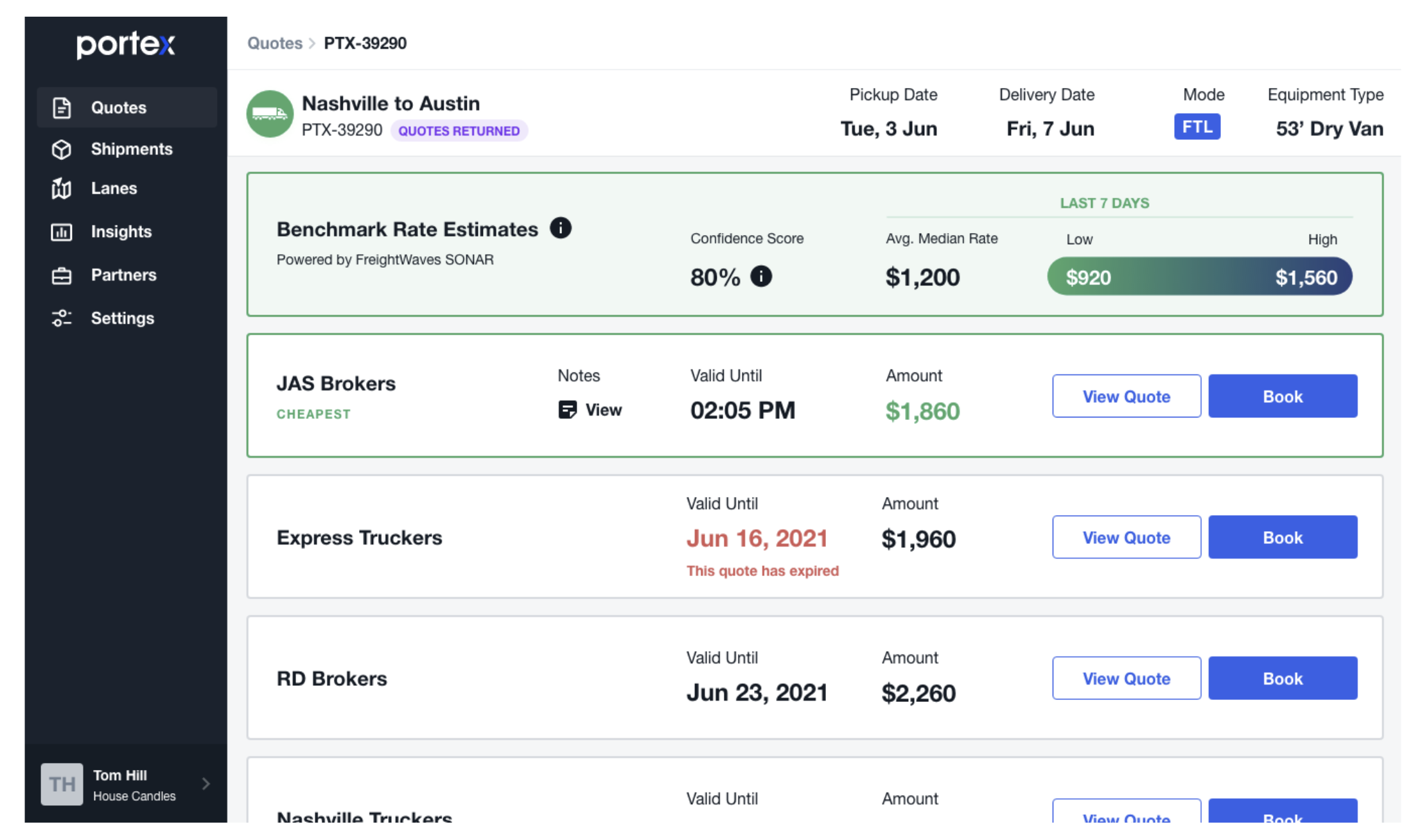
Quote Comparison

Analytics & Insights
CRITICAL REFLECTION
Used the JTBD framework to clearly define the Shipper persona: process, tools, key needs and pain-points
Using data science techniques to augment qual findings, expedite analysis and uncover other missing opportunities
Created a design partner programme to co-design with super users from different customer segments.